Thursday, November 12, 2026

Dan Brown’s New Book and Neurotech

Published on The Daily Tribune, 27 May 2026

------------ 

What is Noetic Science? Neurotechnology? Brain-Computer Interfaces (BCI)?

We may not get full answers to these questions. But, in Dan Brown’s latest book, Secret of Secrets’ there is enough information to pique our interest.

Released simultaneously in 16 languages, in September 2025, it started at the No. 1 position on the New York Times Best Sellers list and stayed there for over 17 consecutive weeks.

Such is the popularity of Dan Brown that his novels now number an astounding 250 million copies in print, in 56 languages.


And such was the growing anticipation of his readers, for this new book – as he hadn’t written one for eight years — that it sold at astonishing speed. It was pre-ordered three months in advance, and flew off the bookstore shelves.

I had not pre-ordered it, and was upset that none of the bookshops in Bahrain had had it during September. My daughter sent a copy from India, through a friend.

“The hallmarks of Dan’s books -- codes, art, history, religion, and cutting-edge science – are on full display alongside a propulsive plot,” said Nihar Malaviya, CEO of publisher Penguin Random House (PRH) Global, at its launch.

And, now that I have read it, I fully agree with him.

But, “there’s nothing in Brown’s new novel to rival the century-spanning Eurocentric conspiracy in The Da Vinci Code,” says Laura Miller’s review in the online magazine, Slate. 

And I agree with this, too.

Yes. I was a tad disappointed, like perhaps many other fans, because it did not live up to our expectations. In a way, he must be blamed. His tight plots with sudden twists used to keep us on tenterhooks. And we cannot expect anything less.

So, why not five stars?

Simple. It feels less like a Robert Langdon thriller and more like a TED Talk in disguise. There’s less mystery, less Langdon, and a lot more science, technology, and brainy conversations. At times, it reads more like a “Web of Science” article than a fast-paced fiction novel.

We know that Dan Brown’s grip on new-age tech is just as good as it’s on art and culture, and history and literature. He shows us that the blending of human consciousness and future-tech is imminent.

The book’s heroine Katherine Solomon specializes in Noetic Science, a field that the Institute of Noetic Sciences (IONS) has been researching since 1973.

“We humans engage with the world in many ways—through instinct, intellect, and intuition,” says the institute on its website. “Noetic sciences offer a framework for understanding how these ways of knowing come together, shaping how we experience reality and expand our understanding of what it means to be human.”

Neurotechnology develops devices and systems that directly interact with the nervous system. They monitor, record, or even alter neural activity. Once science fiction, it is now a reality.

Not just Elon Musk’s Neuralink, but companies such as Synchron, Paradromics, and Blackrock Neurotech are already exploring how the human brain can communicate with machines. They all find a mention in this book.

Their BCI innovations range from therapeutic implants that restore movement to AI-powered systems and wearable devices enhancing human capability.

But, if technology can access thoughts, emotions, and reactions, where do we draw the line between innovation and intrusion?

Neurotechnology promises extraordinary medical breakthroughs, but it also raises difficult ethical questions about privacy, consent, and cognitive freedom.

That is Perhaps Dan Brown’s real success in Secret of Secrets.

The novel may not match the suspense or brilliance of ‘The Da Vinci Code’, but it makes us confront a future already knocking at our doors — a future where the greatest mystery may no longer be hidden in ancient symbols or secret societies, but in the unexplored universe inside the human mind.

Saturday, July 11, 2026

Borders, Passports, and the Price of Security

"Just 140 years ago, no visa was required to enter any country."

When this line appeared on the screen at the end of a movie I was watching, I had to sit bolt upright.

It made me think of all the migration laws being debated in parliaments today and the anti-immigration protests taking place in different parts of the world.


Photo by Nataliya Vaitkevich from Pexels

Are passports, visas, and strict border controls, so recent?

Apparently, that is the truth.

For centuries, people crossed borders freely to live, work and trade. Neither Megasthenes nor Xuanzang, neither Marco Polo nor Ibn Battuta, neither Columbus nor Vasco da Gama needed permission to enter new lands. 

Rulers generally welcomed travellers, recognising the value they brought through knowledge, culture and, above all, commerce. The problems that sometimes accompanied such exchanges are another story for another day.

The passport and visa systems we know today are largely products of the post-First World War world. Following the 'Treaty of Versailles' and the creation of the 'League of Nations', governments sought greater control over the movement of people.

A landmark ruling came in October 1920, when the League of Nations convened the Paris Conference on Passports, Customs Formalities and Through Tickets. It introduced much-needed standardisation. Passports became uniform booklets with prescribed dimensions, and further refinements to visa regulations followed at a subsequent conference in 1926.

The reasons were understandable. Countries emerging from a devastating war were concerned about national security, espionage, economic protection, employment and the management of refugees. 

Empires were collapsing, nationalism was rising, new nations were emerging, and advances in technology had made warfare more destructive than ever before. Governments wanted to know who was entering their borders and why.

That is why, although the idea of a travel permit is ancient, the modern, standardised visa is a surprisingly recent invention.

The Bible records that around 450 BCE, the Persian King Artaxerxes I gave his Jewish cupbearer, Nehemiah, letters of safe passage as he travelled from present-day Iran to Jerusalem. 

Some historians credit King Henry V of England in the fifteenth century with introducing what resembles the first English passport. The oldest surviving passport is believed to be a handwritten document signed by King Charles I in 1641, granting safe passage to an English nobleman travelling overseas.

Interestingly, it was on this very day, 8 July 1796, that the U.S. Department of State issued its first passport to the American diplomat David Humphreys.

While these may be good historical examples, it was only in the twentieth century that passports and visas truly became standard requirements for international travel.

History reminds us that immigration laws have never stood still. They have continually evolved in response to political realities, economic pressures and security concerns. That process continues today. 

In the 2023 Bollywood movie, Dunki – which I had been watching, and which is based on a 'donkey route' of illegal migration - the character Hardy (played by Shah Rukh Khan) argues that borders are designed only for the poor, highlighting the unfairness of immigration laws. 

He says that while the wealthy can easily buy their way into a country, it is really the poor working-class migrants who are treated as criminals for seeking a better life.

Take the Golden Visa programs, for example. According to an article by a group of investigative journalists of OCCRP,  rules may vary from country to country and most governments try to keep the details under wraps, but "the underlying premise is simple: For a sizeable investment, wealthy people can zip to the front of the immigration line for a growing list of attractive countries, including some in the European Union and the United States".

We all agree that every government has a legitimate duty to protect its borders, safeguard national security and ensure opportunities for its own citizens.  

But, at the same time, nations cannot afford to become so inward-looking that they exclude the very people whose knowledge, skills and enterprise can strengthen their economies and enrich their societies.

That is the enduring challenge. Immigration is not simply about deciding who may enter a country.

It is about striking the right balance between protection and openness. Judging by history, that has never been an easy task—and it probably never will be.


***

Saturday, July 4, 2026

250 Years: The US Experiment

One of the best things I did last month, I suppose, was booking a walking tour.

While in Washington D.C., although for a different reason, I decided I would spend one full morning touring the U.S. Supreme Court, the Library of Congress, and, in particular, the Capitol building, including its crypt and the rotunda.

Thanks to Jobert, our main tour guide, I now have a clear insider’s view of the Capitol which is, arguably, the world’s most powerful government building.


Its grand and imposing neoclassical architecture, its role as the active legislative heart of a global superpower, and its function as a universal, globally-recognized, symbol of representative democracy, makes it unique.

Its construction began on September 18, 1793, when George Washington laid the cornerstone. Sadly, however, he did not live to see the opening of this awe-inspiring building in the then-brand-new city named after him.

Rebuilt after the British burned it down in 1814, the current, heavily modified, Capitol building incorporates parts of the original structure. The earlier dome was wooden, while the current one is cast-iron. 

The birth of the United States, however, was not in Washington D.C. It was in Philadelphia, Pennsylvania.

When, 250 years ago, the Declaration of Independence was signed on July 4, 1776, at the Pennsylvania State House—now known as Independence Hall—in Philadelphia, not all 56 signatories were present, but they eventually signed.

The United States Constitution then came into force in 1789, and remains the world's oldest written national constitution still in operation. The Bill of Rights, comprising the first ten amendments to the Constitution, was ratified by 1791 and still serves as a moral compass for law-makers.


US Supreme Court

While this constitution drew inspiration from earlier documents such as England's Magna Carta of 1215, it broke new ground by creating a durable framework built on federalism, checks and balances, and an independent judiciary.

The nation's founders deliberately turned to the ideals of the ancient Roman Republic when designing their new capital and its institutions. As the US Senate itself notes, they sought architecture that reflected the dignity of a republic in a world dominated by monarchies. The Capitol, with its sweeping columns and majestic dome, was intended to symbolize constitutional government and not imperial power.

 
The Capitol Building. The 'Statue of Freedom' on top of the dome is 19 feet tall, though it looks small here

History, however, offers a cautionary tale. Rome remained a republic for nearly five centuries before gradually giving way to empire. France, after its revolution, oscillated between republics, empires and monarchies before eventually settling into a stable republican system. 

Constitutions alone do not preserve democracies. Institutions endure only when citizens and leaders remain committed to them.

 
The Declaration of Independence. John Trumbull's famous painting in the Capitol's Rotunda


Dozens of countries have borrowed elements of the American constitutional model showing us that ‘written constitution’ matters. But even more important are the ‘values’ it seeks to protect: the rule of law, the separation of powers, accountability, and government by the consent of the governed.

Whether today's United States administration reflects the vision of the Founding Fathers depends largely on one's interpretation of current events. Some see a government adapting to twenty-first century realities. Others argue that expanding executive authority, growing bureaucracy, and increasing political polarization have taken the republic further from the founders’ original intent.


Library of Congress


The question is not whether politicians claim the founders’ legacy, but whether they preserve the principles on which the republic is founded. Every generation inherits the same constitutional experiment. Every administration is merely its temporary steward.

As we concluded our tour, Jobert said something profound: "These buildings do not make the country great. It's the people inside them."

He was right. Marble columns, magnificent domes and historic chambers cannot defend democracy on their own. That responsibility rests with the lawyers and judges who interpret the law, the senators and representatives who debate and legislate, the presidents who exercise restraint, and ultimately the citizens who hold them all to account.

Great republics are not sustained by architecture. They are sustained by character.


***

Some other pictures:


One Chief Justice and eight associate justices (total, nine justices) must be on the Supreme Court. Every book on this shelf here is by, or on, one of them. Currently, four women are serving on the United States Supreme Court


With Jobert


Thursday, June 18, 2026

FIFA 2026: A Goal for Growth

The excitement of young men and women in yellow and green jerseys, as I saw them descend the escalator at the airport, made me feel good.

Emblazoned across their jerseys was just one word: Brazil.

When I asked whether they were American fans of the Brazilian football team, or Brazilians who had come to watch the matches, a beaming young man exclaimed in a heavy Portuguese accent, “We Brazil. We come to watch match. Here. Tomorrow.”

It was 12 June, and I had arrived at New York’s JFK Airport. I did not know then that, on the following day, Brazil would play Morocco in the 2026 FIFA World Cup at a nearby stadium.

I realised these fans would soon go to MetLife Stadium, officially designated as the New York New Jersey Stadium, in East Rutherford, New Jersey.


One could sense that football mania had gripped the region, not just through the giant posters, billboards, full-page newspaper ads, or colourful merchandise, but through the very pulse of the city. The infectious excitement was unmistakably in the air.

FIFA 2026 features 104 matches spread across 16 host cities in 3 countries: the United States, Canada, and Mexico.

The stadium hosting the most matches is Dallas Stadium in Arlington, Texas, with nine games. Close behind it, hosting eight games each, are the New York New Jersey Stadium, Los Angeles Stadium, Atlanta Stadium, Miami Stadium, and BC Place Vancouver.


As we drove past the New York New Jersey Stadium, I could not help but admire the massive signboards and preparations for a month-long football fiesta that will culminate in the World Cup Final at the same venue.

The Brazil–Morocco match -- the only Brazil match held so far -- may have ended in a 1–1 draw, but Brazil will always remain one of football’s most celebrated nations. No country has won the FIFA World Cup a record five times, as it has done. Whether they will lift the trophy again is a question only time can answer.

Yet beyond the goals, trophies, and celebrations lies a bigger story. The FIFA World Cup is also a powerful economic engine.

Major tournaments attract millions of visitors and generate billions of dollars in economic activity. Hotels fill up, restaurants welcome new customers, local transportation systems see increased usage, and small businesses benefit from the influx of visitors. From construction workers and hospitality staff to security personnel and event managers, thousands of jobs are created directly and indirectly.

Host nations also use the World Cup as a catalyst for long-term development. Stadiums are upgraded, airports expanded, roads improved, and public transportation strengthened. While football may last only a few weeks, the infrastructure investments often serve communities for decades afterward.

The benefits are not merely financial. The World Cup brings together people from different languages, cultures, religions, and political systems. For a few weeks, billions of people focus on a common passion. Rivalries remain on the pitch, while friendships are built in the stands, airports, restaurants, and city streets.

Consider the United States and Iran, both participants in FIFA 2026. Politics may place nations on opposite sides, and even at war, but sport creates opportunities for respect, dialogue, and shared experiences. Football cannot solve every conflict, but it can remind us of our common humanity.

That may be the World Cup’s greatest achievement. It does not simply crown a champion. It stimulates economies, accelerates development, showcases nations, and unites people across borders. 

In a world too often divided by conflict and uncertainty, FIFA 2026 offers something refreshingly different: a celebration where competition inspires progress, and where everyone, in some way, emerges a winner.

********

For a critical look on the "Fifa Economics" - on how FIFA earns, and how host nations might lose, check out this YouTube video: 

Wednesday, April 8, 2026

Rules of War: Does Anyone Care?

Despite the popular adage—that we often use without much thought—all is not fair. Neither in love nor in war.

So, are there really ‘rules of war’?

Yes, absolutely, says Amnesty International. Today, we know the codification of these rules as ‘International Humanitarian Law,’ which includes the Geneva Conventions recognized by 196 countries, according to its website. Applicable in armed conflicts, the rules are intended to be universal and neutral.

The main objective is to reduce human suffering caused by war. But we can see that it is largely going unheeded.

The fundamental principles of the rules of war—humanity, military necessity, distinction, proportionality, and precaution—are often ignored, if not totally violated.

Baghdad. Picture Credit: Pexels and Khezez

The principle of ‘humanity’ forbids unnecessary suffering, injury, and destruction, while ‘military necessity’ permits only the force required to achieve legitimate military objectives.

And while the ‘distinction’ principle requires parties to differentiate between civilians and combatants, allowing attacks only on military targets and never intentionally on civilians, ‘proportionality’ prohibits attacks on military targets if the expected civilian harm would be excessive compared to the anticipated military advantage. 

The fifth principle, ‘precaution,’ obliges constant care to minimize harm to civilians and civilian objects.

Together, these principles form the core framework guiding conduct in war. But how do they translate into practical obligations?

Practical Obligations

First, civilians must be protected at all times. Even when attacking legitimate military targets, all parties are required to take every possible precaution to avoid or minimize harm to civilians and damage to civilian property. This includes careful targeting and restraint in the use of force.

Second, anyone who falls into the hands of a party to the conflict must be treated humanely. This applies to prisoners of war, detainees, and the wounded or sick, regardless of which side they belong to.

Third, victims of war must be protected through the delivery of humanitarian aid such as food, water, and medicine. Parties must allow and facilitate such assistance.

Finally, these rules must be applied without discrimination—no one should be treated differently based on race, religion, nationality, or political beliefs.

Modern Framework

In modern times, for this framework, we must acknowledge the work of at least four individuals or entities—Henri Dunant, Francis Lieber, the ICRC, and Fyodor Fyodorovich Martens. They turned moral concern into legal norms.

Henri Dunant, moved by the suffering after the Battle of Solferino, wrote A Memory of Solferino. His work led to the founding of the International Committee of the Red Cross (ICRC) in 1863 and to the first Geneva Convention in 1864.

Meanwhile, Francis Lieber drafted the Lieber Code (1863) during the American Civil War under Abraham Lincoln, marking the first comprehensive codification of wartime conduct.

The ICRC, since 1864, has been guiding the development of international humanitarian law, linking humanitarian ideals with state adoption of treaties.

Fyodor Fyodorovich Martens further strengthened this framework through the Martens Clause at the Hague Peace Conference, affirming that even without specific laws, all remain protected by principles of humanity and public conscience.

Geneva Conventions

The most remarkable outcomes from their work are the four 1949 Geneva Conventions, adopted in response to the inhumanities of World War II. They mainly updated and added to previous Geneva Conventions (1864, 1906, 1929).

Today, these four Geneva Conventions and their additional protocols, as international treaties, protect people who do not take part in the fighting (civilians, medics, aid workers) and those who can no longer fight (wounded, sick, and shipwrecked troops, prisoners of war). 

Implementation matters

Yes. This law exists—but without enforcement, it is hollow. 

War may be complex, but humanity is not negotiable. These rules must be upheld, and those who violate them must be held accountable—firmly and without exception.

Countries which say that they targeted a wrong place and unfortunately killed innocents, because they relied on old data, or countries which say that, oh, well, civilians die, it's collateral damage, should be all put to trial.

The International Criminal Court (ICC) in Hague, for instance, must not only try such careless leaders for war crimes, but after trial, even put them in prison, if convicted, as an example to other.

Nations must be questioned and punished, where needed.

Law is no law if it cannot be effectively implemented.

Tuesday, March 17, 2026

Reporters of War: Digital Media Challenges

Wartime journalism demands a particular kind of discipline. It requires restraint, verification, and a deep commitment to accuracy—qualities that are often neglected when events unfold rapidly and emotions run high.


Today’s media environment makes that discipline harder than ever to maintain.
In an era of round-the-clock connectivity and 24×7 news channels, editors and journalists feel relentless pressure to stay ahead of the curve. The fear of being left behind drives many to share information as it happens, in real time.
However, when reporting becomes a race, speed is eagerly pursued, and verification is often neglected. And when verification is neglected, truth becomes the casualty.
The modern digital networks have made the challenge even greater. Images and videos now emerge from every corner of the world within seconds of an event. Cyberspace quickly fills with countless visuals, many captured on high-definition mobile phones by ordinary people who happen to be at the scene.
For journalists competing not only with rival news outlets but also with social media algorithms, the temptation to publish immediately is enormous. News must appear before it becomes stale—before platforms push it down users’ feeds and user attention starts to shift elsewhere.
This urgency often leads to serious mistakes.
Since the start of the latest war in West Asia on February 28, 2026, troubling examples have already emerged. A senior news editor shared videos on social media that were entirely incorrect: buildings in Bahrain were presented as buildings in Dubai, and an old video of a drone strike in Kyiv, Ukraine, in 2024 was circulated as a new attack in Manama, Bahrain, in 2026.
In another instance, a well-known television news anchor announced arrests that had never actually taken place. The information, apparently received from unnamed sources, was later debunked and quietly retracted.
At the same time, AI-generated images of drones and missiles have circulated online as though they depict real events.
What makes these incidents particularly concerning is that this misinformation did not originate from some anonymous social media users. It was shared by professional journalists and established news outlets—the very institutions we rely upon to verify facts before broadcasting them to the public.
Too often, sensationalism and speed appear to take precedence over accuracy. News is forwarded and amplified before its authenticity is confirmed.
In our digitally connected world, the consequences are serious. False information spreads at extraordinary speed. Before journalists have time to correct themselves, misleading posts may already have been shared thousands of times.
By then, the damage is done, and, even if corrected, the truth may never travel as far as the falsehood.
If journalists must really be respected as purveyors of truth, especially in times of war, they must exercise discipline and caution. 
The responsibility of journalism is not merely to be first, but to be right.
News organizations may feel pressure to compete with rival channels, and to satisfy the relentless demands of the digital news cycle. Yet their highest responsibility is not to power, nor to algorithms, but to the public they serve.
In moments of conflict, when fear and uncertainty run high, misinformation can inflame tensions, deepen divisions, and distort reality.
Truth, verification, and restraint must remain the core principles of journalism. Speed may win attention for a moment, but credibility is what sustains trust over time. And in the end, it is credibility—not immediacy—that defines the true value of journalism.

----- ----- ---- 

Saturday, June 8, 2024

Indian Elections: The Greatest Democratic Exercise


Indian Parliament Buildings in New Delhi

The results of the biggest elections on Planet Earth are out. And what do they tell us about Indian democracy?

Before we answer that question, it is important to understand why these elections are the biggest. 

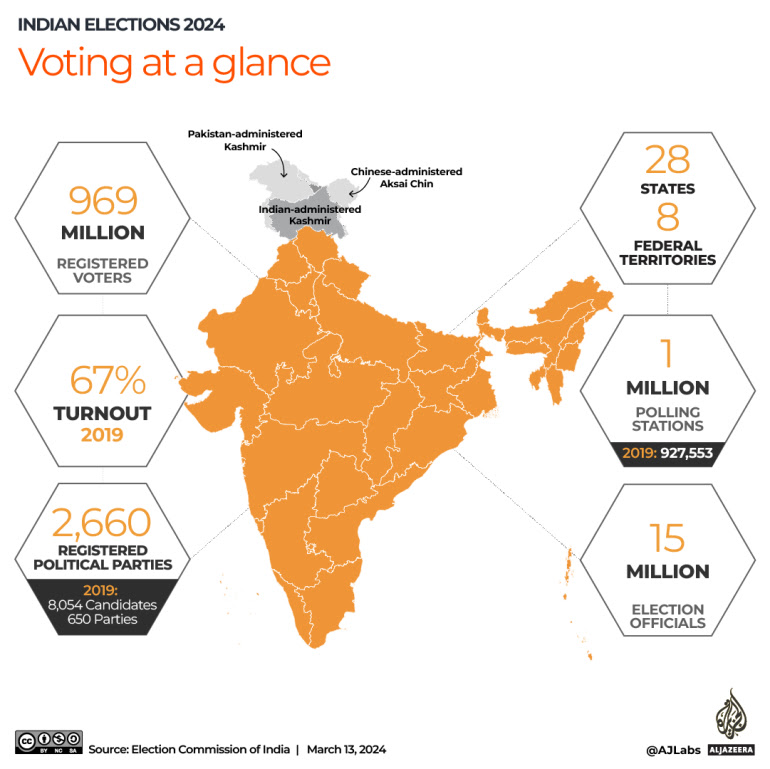
In 82 days, in 7 phases, 969 million registered voters had to go to over 1 million polling stations to vote. Now, that is no small number.

For perspective, the Indian voting population is greater than all the voters of the USA, Indonesia, Pakistan, Bangladesh, Russia, Mexico, and South Africa put together. 

From another perspective, the Indian voters’ number is greater than all the population in all the European countries combined. 

Source : Al Jazeera

By the end of the day, on 1 June 2024, when elections across India were completed, the total number of voters who eventually turned up to cast their ballot was 642 million, 

The 66% voter turnout, from those eligible to vote, is the same percentage of voter turnout that the 2020 US Presidential elections had had. But the US voter turnout was not even 160 million.

Source : Al Jazeera

On June 3, the Indian Chief Election Commissioner Rajiv Kumar announced that the voter turnout figure surpasses the combined total voters of the G7 nations by 1.5 times.

This 14.4 billion US dollar electoral process had involved an extensive operation.  Around 15 million election officials and 68,000 monitoring teams ensured that the voting experience was smooth.

So, all of India was waiting for June 4, after 82 days of patience, to hear the election results. 

Prime Minister Modi’s political party, Bhartiya Janata Party (BJP), for the third consecutive time, got the greatest number of seats (240 seats) by any political party, but that number was not enough.

The parliament’s lower house (Lok Sabha) has a total of 543 seats, for which people vote. So, any party, or a coalition of parties, with a simple majority of 272 seats, can rule for a 5-year term.

A coalition called the National Democratic Alliance (NDA), which has BJP and some other allied parties in the alliance, can claim 292 seats which the NDA has collectively won; and form the government as a coalition. 

Modi would then become the second PM, after Nehru, to become the prime minister of India, for the third time consecutively.


Source : Al Jazeera 

In his earlier two terms, having won more than the required 272, the BJP - with its 282 seats won in 2014 and with 303 in 2019 - had no real need for any coalition. 

The NDA (BJP with its allies) had gotten 336 seats in 2014 and 353 seats in 2019 and, in a way, decimated almost all opposition in the parliament.

Now, in 2024, NDA has won 293 seats and will form the government. And, the INDI Alliance or I.N.D.I.A (Congress Party and its allies) with 234 seats will sit in the opposition benches. 

India, as a nation, should be happy with this because finally, a healthy opposition is now a reality.

There were speculations that some parties within NDA, such as Chandrababu Naidu’s Telugu Desam and Nitish Kumar’s Rashtriya Janata Dal (RJD), may defect from the NDA bloc to INDI alliance (I.N.D.I.A). 

If that had happened, it could have been a huge power shift in the elections and some confusion. But NDA (BJP and allies) has collectively chosen Modi to lead as the Prime Minister, again.

What does all this tell us? 

It tells us that electoral democracy has matured and is thriving in India.

The humongous size of the population, the complexity of religions, castes, and subcastes, the numerous languages, cultures, and customs, the ideological differences of the political parties, and the passionate debates that rage on stages and TV channels are all there. But the citizens of India know that the vox populi will be heard.

The absence of political violence despite fiery speeches, and the acceptance of results by all parties, with no allegations of voter fraud or rigging, shows us one thing. In India, democracy has matured.

There is a new respect for the voice of the people, for the value of the ballot, and for the power of democracy.


  • For the PDF file of the newspaper page, CLICK HERE
  • For the PDF of the full newspaper (check page 4) of that day, CLICK HERE


___

Sunday, August 20, 2023

Religious Freedom : How Important is it?

“I congratulate Bahrain, a country hosting a diverse population with diverse faiths, for its efforts to promote inter-religious dialogue and tolerance” said Eamon Gilmore, the EU Special Representative for Human Rights, last week.

These words, of the former Deputy Prime Minister of Ireland, endorse Bahrain’s proactive stance in the Arabian Gulf region, on addressing matters related to religious faith, or of its differences thereof.

He was speaking, online, at the conclusion of the EU-Bahrain conference – held under the patronage of His Majesty King Hamad bin Isa Al Khalifa - titled ““Broadening the Tent: Freedom of Religion and Belief” (For the full speech information click here )

As I heard the EU Human Rights’ leader appreciating the fostering of exchanges between governments, decision-makers and civil society organisations, at this 3-day EU-Bahrain conference, I found many phrases from his speech worthy of extensive rumination.

For instance, “No one should be persecuted or privileged because of their religion or belief”, he said at this conference, organized by the King Hamad Global Centre for Peaceful Coexistence and “This is Bahrain” society.

While ‘persecution’ some people face for religious beliefs is generally talked about, the ‘privilege’ that some people enjoy because of their religion, in certain geo-political environments, is often ignored.

In some countries, discrimination and injustice is often a result of how minorities are made to live in fear, or under threatening environments, by robbing them of a life of dignity. This happens when majorities actively campaign against the minorities, from the majorities’ own privileged positions, or from their secure comfort zones.

It was therefore nice to hear Dr. Shaikh Khalid bin Khalifa Al Khalifa, the head of the King Hamad Centre of Peaceful Coexistence, say that Bahrain is open to people of all ideals, beliefs and religions, including those of religions that are yet to be formed!

Eamon Gilmore, the EU Special representative, had also said, “Any attack on any religion or faith is an attack on all religions and people”.

While this phrase denounces all religious attacks, it also uplifts all religions as belief-systems worthy of respect.

In a panel discussion, one speaker had said that we must focus on the commonalities of religions, and ignore the differences. But
then, another speaker objected and said that we must, in fact, celebrate the differences, and appreciate our diversity of thought. Such was the mood among the attendees.

Betsy Mathieson, Deputy Chairperson of the Board of Trustees of the King Hamad Global Centre for Peaceful Coexistence, and the President of “This is Bahrain” society, had already mentioned this aspect of Bahrain, at the beginning of the conference, when she spoke about this nation's beautiful diversity; and how various religious communities live together in harmony. 


 Dr. Shaikh Khalid bin Khalifa Al Khalifa, speaking at the conference.

Another line of the EU Special Representative’s that I found powerful is this: “Freedom of religion or belief should never undermine other rights, nor be used as a justification for violence, bigotry or discrimination”.


In the media, we regularly see religion being used by politicians as a leveraging factor for getting elected, or for pulling down governments. It often leads to violence that is entirely preventable, if only religious communities see the value of mutual respect.  

By also saying that “we condemn the criminalisation of apostasy and the abuse of blasphemy laws”, Eamon Gilmore stressed that governments must make appropriate legislations, to protect the persecuted.

In some countries, blasphemy laws are frequently used to target minority groups, and in some, death sentences are issued when people become apostates.  And these topics, however uncomfortable they sound, require serious addressing. And this conference did just that; and more.

Now that this EU-Bahrain conference is becoming an annual event, we can look at the future, with broader minds and with greater optimism.


Saturday, May 28, 2022

Another Mass Shooting: Will the US 'Gun Laws' Change?


Is it just another day in the USA, with yet another shooting at school?

From long before this Robb Elementary School shooting in Uvalde, Texas, there have been scores of incidents of gunmen going berserk in the USA. But, there is hardly anything done to prevent gun sales.

In fact, a study found that 7.5 million US adults - almost 3% of the population - became new gun owners between January 2019 and April 2021 (çlick here, for the study).

According to a BBC report, “the US ratio of 120.5 firearms per 100 residents, up from 88 per 100 in 2011, far surpasses that of other countries around the world”.

The United States, Yemen, Switzerland, Finland, and Cyprus are the top five countries in the world with gun ownership. But, here’s something more shocking. US gun ownership is nearly double that of Yemen’s, its closest contender.

But, why should ordinary citizens have access to deadly firearms? 

Common sense tells us that, even if we ignore pistols or revolvers, civilians should never own lethal automatic or semi-automatic assault guns.

But the powerful gun lobby will cite the Second Amendment of the US Constitution, from the Bill of Rights, which gives its citizens the right ‘to keep and bear arms'.

However, many fail to note that the US Constitution became effective in 1789, and its first 10 amendments, called the Bill of Rights, were ratified in 1791. It was in an era completely different from that of the 2020s.

The US founding fathers probably never imagined the shape of things to come. They may not have visualized automatic and semi-automatic assault weapons, or these extremely violent video games to which the youth are being exposed now.

The USA’s National Rifle Association (NRA) argues that more guns make a country safer. They had even argued– in the 2012 Sandy Hook Elementary School shooting case in Connecticut, which killed 26 people – that an armed guard would have lessened the deaths. 

Their logic is that if everyone is armed, in self-defense, it will reduce deaths. Citizens can even protect themselves from the government if it becomes evil.

Let’s take the case of an Australian mass shooting in 1996. In Port Arthur, Tasmania, 35 people were brutally killed by a gunman Martin Bryant.  Intellectually disabled, with a history of erratic behaviour, he had later pleaded guilty, but never gave a reason for his gruesome killing.

The then Australian Prime Minister John Howard soon banned almost all fully-automatic or semiautomatic firearms. And the government even instituted a gun-buyback program which made people surrender some 700,000 firearms. The guns were later destroyed.

The Australian said he had taken inspiration from another case in Scotland, a few months earlier. A gunman had invaded a primary school in the town of Dunblane and shot to death 16 young children and their teacher.

The UK Parliament immediately passed a law banning private ownership of handguns above .22 calibre; and in a few months, the ban got extended to “all handguns”.

Following mass shootings, both Australia and the UK had responded swiftly with tighter gun laws. But the US is just not going that way.

In 2022 so far, there have already been more than 200 mass shootings in the USA – of which 27 are school shootings - according to the Gun Violence Archive, an independent data collection organization.

But, seemingly, the correct number of mass shootings, which should invoke gun law reforms, has not been reached, yet.

---  ---


Twitter handle: @joelindrupati 

Thursday, December 16, 2021

Bahrain's National Day: Many Reasons to Celebrate


As Bahrain gets ready to mark its 50th National Day, it is evident that this beautiful island nation has many good reasons to celebrate.

To start with, we have just seen that in this pandemic, Bahrain has been ranked ‘first’, globally, on the ‘Nikkei Covid-19 Recovery Index’ in November 2021.

With a drop in active cases, an increase in vaccination rollout, and a continued adherence to precautionary measures, aimed at mitigating the pandemic, it is no surprise that Bahrain has come on the top.

Citizens and residents alike would vouch for the swift and smooth approach of this country’s leadership, in handling this unprecedented global health crisis.

Several other global indices also show us that Bahrain’s standing is certainly praiseworthy. And these 50 years of sovereignty are worthy of all festivities we can gear up for.

In the World Happiness Report 2021, Bahrain has been ranked third in the Arab world and 35th globally.  Out of over 150 nations surveyed by the UN Sustainable Development Solutions Network, Bahrain’s position is no small achievement.

On the Human Development Index, Bahrain has also moved up to rank 42nd globally in 2019, three positions better than its 45th ranking in 2018.

Based on average income, education, and health metrics, this United Nations Development Programme (UNDP) HDI report says that Bahrain has maintained its position in the “very high human development” category of the index.

HDI is a summary measure for assessing long-term progress in three basic dimensions of human development: a long and healthy life, access to knowledge, and a decent standard of living.

Measured by life expectancy, by the mean-years of schooling among adult population, and also by the Gross National Income (GNI) per capita expressed in constant 2017 international dollars converted using purchasing power parity (PPP) conversion rates, HDI shows us how Bahrain’s metrics can make us proud, when looked at, in comparison with over 180 countries.

From 1995 to 2020, we can see a smooth and steady growth in Bahrain’s position on the HDI.


On the 2021 Index of Economic Freedom too, Bahrain is ranked 4th among 14 countries in the Middle East and North Africa region, and its overall score is above the regional as well as world averages.

Bahrain is also the 40th freest economy in the 2021 Index, according to the Heritage Foundation. Thanks to the excellent work being done by the EDB (Economic Development Board) and the government legislative structures which are constantly striving to make Bahrain business friendly, we can see economic progress.

Importantly, Bahrain still remains the best place in the GCC for expats to live and work despite the COVID-19 pandemic, according to the recently published InterNations Expat Insider 2021 survey.

The survey, which samples key indices related to things like quality of life and cost of living, ranks this country ahead of Qatar, the UAE, Oman, Saudi Arabia and Kuwait.

Expat Insider Survey 2021 by InterNations - Regional Picture of GCC States

When it comes to customer satisfaction, on Avaya Global Happiness Index, Bahrain topped the index in six of the verticals – banking, telecoms, online retail, in-store retail, utilities and airlines – and came second in the hotels vertical.

In the Global Knowledge Index 2021, Bahrain is now at 55th position. This ranking becomes more significant when we realise that this is a small country among 154 countries surveyed. And also when we realise that for this ranking, GKI includes 155 variables, selected from over 40 sources and international databases including the UNESCO, World Bank, ITU, and International Monetary Fund (IMF), Organisation for Economic Cooperation and Development (OECD) and International Labour Organisation (ILO).

Interestingly, on the World Giving Index 2021, Bahrain was ranked first among Arab countries and 12th globally, showing that this nation is generous on charitable and humanitarian work.

In conclusion, I must say, this grossly insufficient column space cannot fully list Bahrain’s many reasons to celebrate. But it argues well, I hope, that we must celebrate. 

Wednesday, October 6, 2021

Nobel Prizes and Surprises


In the month of October every year we hear the announcements of Nobel Prize winners. And in December every year, for nearly 120 years, we have seen them being awarded to – arguably - to the world's greatest men and women in their respective fields.

Since 1901, a total of 935 individuals and 25 organizations have been given this prestigious award. And, I thought, a brief retrospective comment on this Nobel Prize history could be share-worthy.

Like, for instance, that Marie Curie is the only lady who won twice. Once in Physics (1903) and then, again, in Chemistry (1911).

Becoming a bit curious about this Curie, I dug deeper.  And as Curie’s cat, not Schrödinger’s (Schrödinger, by the way, also won a Nobel in Physics in 1933), I found some startlingly pleasant information.

Apart from Marie Curie, there are others who have won the Nobel Prize twice. Linus Pauling received Nobel Prizes in Chemistry (1954) and Peace (1962), John Bardeen twice, in Physics (1956 and 1972), and Frederick Sanger twice, in Chemistry (1958 and 1980). 

Marie and Pierre Curie’s is, perhaps, the only family that can be correctly called 'a family of Nobel Laureates'.  Their daughter, Irene Curie won a Nobel Prize, later. 

And, fascinatingly, Irene Joliot nee Curie - like her father and mother – also shared the Nobel with her husband, Fredric Joliot (Chemistry, 1935). 

Like these two couples, another wife-husband couple, Gunnar Myrdal and Alva Myrdal, also won Nobel Prizes, but it was not a shared Prize. Gunnar won it in Economics (1974), and Alva won it for Peace (1982). 

A father-son couple included Sir William Lawrence Bragg, who at age 25, was the youngest person ever to win the Nobel Prize, until Malala Yusufzai (Peace, 2014) became the youngest by getting the award at 17 years. 

Famously, the Nobel Prize was refused twice. The French writer Jean Paul Satre refused the Prize for Literature on the grounds that such honours could interfere with a writer's responsibilities to his readers. And the Russian writer, Boris Pasternak, the author of Dr Zhivago, was forced not to accept it, by the then Soviet Government. 

Interestingly, six Indians have won the Nobel Prizes, so far, and in almost every category.  Rabindranath Tagore (Literature, 1913), C V Raman (Physics, 1930), Mother Teresa (Peace, 1979), Amartya Sen (Economics, 1998), and Kailash Satyarthi (Peace, 2014). The Chemistry Prize has been evading the Indian subcontinent. 

Nobel laureates born in India, but who’d become US or UK citizens were:  Hara Gobind Khorana (Medicine, 1968), Subrahmanyan Chandrasekhar (Physics, 1983),  Venkatraman Ramakrishnan (Chemistry, 2009) and Abhijit Banerjee (2019, Economic Sciences). 

No woman had won the award for economics until 2009, when Elinor Ostrom received the prestigious Nobel Memorial Prize in Economic Sciences. 

However, to be technically correct, there was one woman who received money for economics earlier.  Robert E. Lucas in 1995 had to, on personal account, share his Economics prize money with his ex-wife. She had had her lawyer cleverly insert a clause in their divorce papers, to make the husband share the money if he ever won a Nobel! 

Another amazing piece of information I stumbled across, on the internet is this. That Bronx Science High School, Bronx, New York, is the high school from where the most number of Nobel Laureates came than from any other high school in the world !! It has eight Nobel laureates among its alumni! 

So you now know in which high school you must join your kid if you want him or her to become a Noble Laureate. But be sure that he or she becomes a US citizen first.  

And maybe marrying a descendant of the Curies could prove extremely helpful!

--------------------------

For this article - an older version - published in my weekly column in Daily Tribune, click here